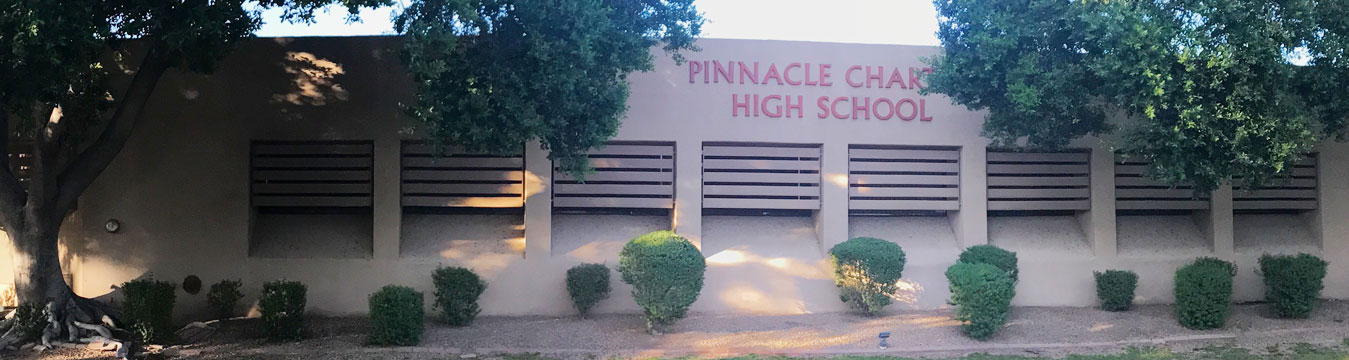








PINNACLE ONLINE HIGH SCHOOL COURSE CATALOG
The online high school courses offered at Pinnacle Online High School were designed to allow students to thrive in a self-paced learning environment.
As a fully-accredited institution by the North Central Association and CITA, Pinnacle Online High School courses are transferable and accepted by school district throughout Arizona and across the country.
Language Arts | Science | Social Studies | Mathematics | Elective Courses/Foreign Languages
Language Arts
| English 1A | English 1B | |
| English 1A is the first semester course of a two-semester series with topics focusing on family relationships and interactions. This course also concentrates on the foundational skills of vocabulary and grammar, and introduces students to the formal writing process. |
English 1B is the second semester of a two-semester series. While exploring literature on themes of overcoming obstacles and challenges, students practice writing and continue to work on their foundational reading and grammar skills. |
|
| English 2A | English 2B | |
| English 2A is a first semester of sophomore English. Students are exposed to a variety of literary elements to help them explore these new writing genres, such as short stories and poetry, focusing on the themes of familiar and romantic love. |
English 2B continues to explore the writing genres with a focus on nature. Students continue the exploration of literary elements, learning to clearly communicate in the written form. Throughout this course students review foundational skills such as punctuation and reading strategies while exploring the various forms of literature. |
|
| English 3A | English 3B | |
| English 3A is the first semester of junior English. Readings and writing activities focus on heroism. The course was designed to help students analyze a variety of texts as they focus on proper essay writing, and the overall organization needed to write effectively. |
The American Experience is the focus of English 3B. In this course, students analyze and evaluate literature as well as non-fiction and fictional texts. Students further develop their essay writing skills through an in-depth review of the writing process. |
|
| English 4A | English 4B | |
| This course is focused on British and classical literature, where the student will experience the trials and tribulations of this genre of literature and art. Students are encouraged to do outside reading through the use of a book report. Skills covered within the reading packets include enhancing vocabulary, identifying literary terms, and analyzing various forms of literature for their use of literary terms. |
This course covers the diversity of literature, exploring a wide range of topics in the various writing forms. Students continue to hone their foundational skills such as punctuation and grammar through their writing and assessments. |
Back to top
Science
| Life Science A | Life Science B | |
| Life Science A examines basic concepts in biology and chemistry including: the scientific method, cell structure and function, nucleic acids, protein synthesis, cell division, meiosis, and inheritance. |
Life Science B introduces different theories of evolution and classification systems. In addition, this course discusses the biosphere, populations and communities, and the impact of human influence on this system. | |
| Physical Science A | Physical Science B | |
| Physical Science A is the first semester course of a two-semester series. Students in this course will use and apply the scientific method, understand matter, mixtures, compounds, elements and the periodic table. |
Physical Science B examines the basic concepts in physics with additional exposure to the scientific method. Students in this course will be introduced to: force, Newton's Laws, gravity, pressure, work, power, energy (kinetic and potential) and heat. |
|
| Earth Science A | Earth Science B | |
| Earth Science A is an in-depth study of Earth as a system. This course discusses the different branches of Earth science and introduces the student to the scientific method. |
Earth Science B examines several dynamics of Earth and space. Topics include: the ocean, continental drift, mountain building, geologic time scale and dating techniques. | |
| Biology A & B | Chemistry A & B | |
| This two-semester course is an introduction
to general biology and to the processes of scientific inquiry
and thinking. It will include the fundamental principles of living
organisms including physical and chemical properties of life,
cellular organization and function, the transfer of energy through
metabolic systems, cellular reproduction, the classification
of living things, the six kingdoms of life will be examined.
The main focus is to present biological information in an understandable
and straight forward way that will capture the students’ interest
dealing with up to date principles and concepts. |
This two-semester course adheres closely to standards for the teaching of chemistry. It emphasizes the mathematical, theoretical and experimental basis of modern chemistry. Emphasis is placed on the use of theoretical and mathematical concepts to explain and predict chemical behavior. An overview of the significant learning objectives that are presented in this course include Measurement, Atomic Structure, Chemical Bonding, Conservation of Matter, Stoichiometry, Gases, Acids and Bases, Solutions, Chemical Thermodynamics, Reaction Rates, Chemical Equilibrium, Organic Nomenclature, Biochemistry, and Nuclear Chemistry. | |
| Physics A & B | ||
| This course is designed to acquaint
you with topics in classical and modern physics. The course covers
two semesters. The first semester discusses topics in Newtonian
mechanics, oscillatory motion, waves and static electricity.
The second Semester discusses the topics of current electricity,
magnetism, electric circuits, sound, fluids and gases, heat,
and modern physics. The course emphasizes conceptual understanding
of basic physics principles, with some problem solving. There
are interactive conceptual and basic problem-solving examples
throughout the lessons. The student also gains laboratory experience
through interactive lab simulations and in-school labs. A knowledge
of second year algebra and very basic concepts in trigonometry
is required for the course. |
Back to top
Social Studies
| US/Arizona History A (also available as US History for students outside of Arizona) | US/Arizona History B (also available as US History for students outside of Arizona) | |
| US/Arizona History A is the first course of a two-semester series which begins with the Technological Revolution and covers American history up to President Roosevelt and his New Deal. |
US/Arizona History B is the second course of a two-semester series. The class begins with a review of Roosevelt's New Deal and covers American History to Watergate and its aftermath | |
| World History/Geography A | World History/Geography B (also available without the Arizona focus for students outside of Arizona) | |
| World History and Geography A is the first semester course of a two-semester series focusing on the history of the world from the earliest of civilizations to just before World War I. The course also covers geography and cultural history related to the various regions. |
World History and Geography B focuses on the history of the world from the causes and effects of World War I to the issues of today. The course also covers the geography of parts of the world as well as the geography and history of the state of Arizona. |
|
| Economics | US/Arizona Government (also available as US Government for students outside of Arizona) | |
| This course covers basic concepts in economics and financing. At the completion of this course the student will be able to demonstrate competencies various free enterprise topics. |
This course covers basic concepts in American government. Students will learn such ideas as the origins and principles of government to the concepts of state, local and federal governments. |
Back to top
Mathematics
| Basic Math A | Basic Math B | |
| Basic Math A covers basic math topics including number sets, place value, basic operations, integers, decimals, fractions, probability, as well as an introduction to pre-algebra. |
Basic Math B covers topics including triangles, quadrilaterals, prisms, circles, US measurement, metric measurement, data and graphs, as well as a review unit and an introduction to pre-algebra. |
|
| Pre-Algebra A | Pre-Algebra B | |
| Pre Algebra A is the first semester course of a two-semester series. It covers basic pre-algebraic concepts that include variables, one and two-step equations, integers, ratios and proportions. |
Pre Algebra B is the second semester course of a two-semester series. It covers pre-algebraic concepts to include problem solving, measurement, geometry, probability and statistics, and one and two step equations and inequalities. |
|
| Algebra 1A | Algebra 1B | |
| Algebra 1A begins with the fundamentals of algebra. The course covers the real number system, variables, expressions, properties of real numbers, solving and analyzing linear equations, graphs and functions, and analyzing linear inequalities. |
Algebra 1B is designed to expand on the fundamentals of algebra. The course covers systems of equations, quadratic equations, monomials, properties of exponents, analyzing graphs and functions, radical expressions, probability, permutations, and combinations. |
|
| Geometry A | Geometry B | |
| Geometry A begins with an overview of basic geometry terms. The course also covers problems involving line segments, complimentary angles, and supplementary angels. Other topics covered are theorems of parallel and perpendicular lines, theorems of triangles, proofs, the coordinate plane, and understanding transformations. |
Geometry B begins with determining perimeter, area, and volume of 2-D and 3-D geometric shapes. The course also covers circumference and area of circles and spheres. Other topics covered are similarity, trigonometric ratios, vectors, and relationships of tangents, chords, secants, and inscribed angles. |
|
| Algebra 2A & 2B | ||
| This two-semester course teaches fundamental concepts such as integers, linear equations, adding, subtracting, multiplying and dividing monomials and polynomials, factoring and solving quadratic equations. Radicals and exponents are also explored. |
Back to top
Electives & Foreign Language
| Business Management Technology | World of Work | |
|
In this course, students study general business practices. The goal of this
course is to prepare students for the economic roles of consumer, worker, and citizen. |
World of Work combines classroom theory with supervised work experience. Students have the opportunity to earn
high school credit for planned growth in a job that is related to their career goals.
Available only at on-campus locations |
|
| Sports Marketing | Introduction to Art | |
| This course takes students on a journey through the world of marketing within the fields of sports and entertainment. |
Throughout this course, students learn how culture, time, and place influence artists and the art they create. Students analyze how art can be used to express themselves and their ideas by creating their own art work. |
|
| Fundamentals of Health | Computer Fundamentals A & B | |
| This course provides students with a broad overview of health and wellness. The goal of this course is to provide students with a working knowledge about health issues such as fitness, nutrition, disease, and personal choices. |
In this introductory two-semester course,
students learn how to use Microsoft Word, Excel and PowerPoint
2000 to create, analyze, edit, share and publish information for
a variety of audiences and purposes. Through step-by-step tutorials
and a project-based approach to learning, students become familiar
with the key concepts and basic skills of today's information technology
sector. |
|
| AIMS Reading (.5 credits) or AIMS Writing (.5 credits) or AIMS Math (.5 credits) | ||
| These AIMS Preparation and Arizona Standards Mastery Program are specially designed to help students master the content specified in the Arizona Content Standards. These courses’s focus on the Arizona Content Standards which enable students to improve their performance in all skill areas (Reading, Writing & Math) tested on the AIMS in high school. A passing score is required in all three skill areas: AIMS Reading, AIMS Writing & AIMS Writing, in order for any Arizona student to graduate from high school. | ||
|
NOTE: Language classes require a computer equipped with a
microphone and speakers/headphones.
|
||
| Spanish IA | Spanish IB | |
| Spanish I A is the first course in a two-course series that has been carefully designed to meet the standards of the American Council on the Teaching of Foreign Languages (ACTFL). These standards call for a method of teaching that focuses on successful communication through speaking, writing, reading, and listening, as well as a thorough grounding in aspects of culture. First semester Spanish students learn to spell and count in Spanish, introduce themselves and greet others, and describe friends, family, belongings and where they live. Students also learn to express likes and dislikes, talk about responsibilities and everyday activities, make invitations, and discuss plans for the near future. Grammar concepts include noun-adjective agreement, basic verb conjugation, common irregular verbs like ser and estar, the simple future, and tab questions. Cultural information from Spain, Puerto Rico, Texas, Chile, and Costa Rica is also introduced. | Spanish I B is the second course in a two-course series carefully designed to meet the standards of the American Council on the Teaching of Foreign Languages (ACTFL). These standards call for a method of teaching that focuses on successful communication through speaking, writing, reading, and listening, as well as a thorough grounding in aspects of culture. First semester Spanish students learn about food, daily routines, giving opinions, talking about plans, and past holidays. Students practice giving information and expressing hopes and wishes. Grammar concepts include using direct object pronouns, affirmative informal commans, reflexive pronouns, infinitives, adjectives, preterite of reflexive pronouns, present progressive and irregular verbs. Cultural information from Latin American countries such as Mexico, Argentina, Florida, Dominican Republic, and Perus is also introduced. | |
| Spanish IIA | Spanish IIB | |
| Spanish IIA is the first course in a two-semester series designed specifically for students who have successfully completed Spanish IA & B. Activities and tests are designed to accommodate the early stages of language acquisition; grammatical structures and lexical items presented accordingly. Activities are designed to practice and consolidate all language skills: listening, speaking, reading, and writing. Cultural readings to expand vocabulary, stimulate discussion, and broaden students’ understanding of the Hispanic world.
Third semester Spanish students learn to talk about likes and dislikes, things that happened in the past, food and restaurants, shopping, preferences, a place and its climate, wishes and hopes, recommendations, and news. Grammar concepts introduced include regular, stem changing, and irregular verbs in the preterite, imperfect, subjunctive, future, present perfect and present progressive tenses. Other grammar concepts include verbs with reciprocal actions, adverbs, double object pronouns, past participles, and comparatives and superlatives. Cultural information from South American, North American, and European countries such as Spain, Argentina, Chile, and the United States is introduced. |
Spanish IIB is the second course in a two-semester series designed specifically for students who have successfully completed Spanish IA & B. Activities and tests are designed to accommodate the early stages of language acquisition; grammatical structures and lexical items presented accordingly.
Fourth semester Spanish students learn how to talk about likes and dislikes, things that happened in the past, food and restaurants, shopping, preferences, a place and its climate, wishes and hopes, recommendations, and news. Grammar concepts introduced include regular, stem changing, and irregular verbs in the preterite, imperfect, subjunctive, future, present perfect and present progressive tenses. Other grammar concepts include verbs with reciprocal actions, adverbs, double object pronouns, past participles, and comparatives and superlatives. Culture information from South American, North American, and European countries such as Spain, Argentina, Chile, and the United States is introduced. |
|
| German IA | German IB | |
| German IA has been carefully designed to meet the standards of the American Council on the Teaching of Foreign Languages (ACTFL). These standards call for a method of teaching that focuses on successful communication through speaking, writing, reading, and listening, as well as a thorough grounding in aspects of culture. Each unit embodies all of these standards in accordance with the theories described in this document. Unit activities blend different forms of communication and culture to ensure that the student meets all standards. Course strategies include warm-up activities, vocabulary study, reading, threaded discussions, multi-media presentations, self-checks, practice activities and games, oral and written assignments, projects, quizzes, and exams. Learning activities in each unit are focused upon a specific theme such as weather, time, food, and family. | German IB has been carefully designed to meet the standards of the American Council on the Teaching of Foreign Languages (ACTFL). These standards call for a method of teaching that focuses on successful communication through speaking, writing, reading, and listening, as well as a thorough grounding in aspects of culture. Each unit embodies all of these standards in accordance with the theories described in this document. Unit activities blend different forms of communication and culture to ensure that the student meets all standards. Course strategies include warm-up activities, vocabulary study, reading, threaded discussions, multi-media presentations, self-checks, practice activities and games, oral and written assignments, projects, quizzes, and exams. | |
Back to top


